

MDS is a technique for improving the performance of D/A converters. Its history reaches back to the MMB (Multiple Multi-Bit) D/A converter section of the Digital Processor DC-91 introduced in 1992, which had a large number of multi-bit D/A converters operating in parallel. This also formed the base for the MDS+, MDS++, MCS, and MCS+ developments.
The MMB D/A converter reduces conversion errors by using multiple D/A converters connected in parallel. The result is higher dynamic range, better linearity, and lower harmonic distortion, as well as improvement in other areas.<br />
Figure 1 shows a block diagram of the MMB principle. The same digital signal is supplied to each converter, and the analog outputs of the converters are added up to arrive at the overall output signal.
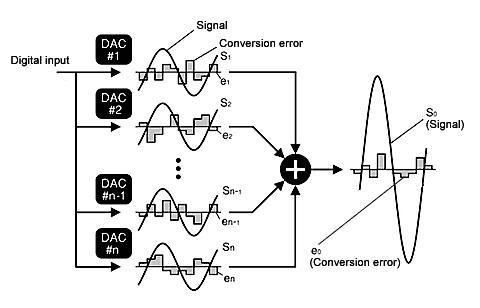 Fig. 1 MMB operation principle
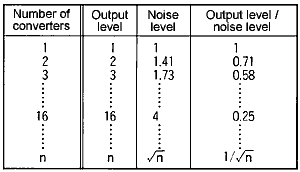
Because the outputs of the converters are added up, the overall output will increase by a factor of n when there are n converters. However, the conversion errors occurring in each converter have different properties (they do not have a fixed phase relationship) and therefore do not add up to n times. Rather, the error increase factor here is the square root of n (<root>n). On the other hand, the relationship between output level and conversion error is 1/<root>n. This means that the conversion error becomes 1/<root>n. Consequently, all important performance characteristics of the D/A converter such as dynamic range, linearity, THD etc. are improved.
In the case of the DC-91, sixteen 20-bit D/A converters are used in parallel which means that compared to a single converter, the conversion error is 0.25 (=1/<root>16), which closely approximates 20-bit performance.
A major advantage of the MMB principle is the fact that its performance improvements are obtained uniformly throughout its operation range, regardless of the signal frequency or level. This elegantly solves one of the major problems inherent in conventional multi-bit D/A converters, namely linearity at very low signal levels.
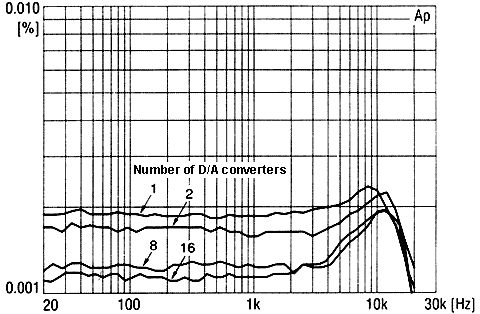 Fig. 2 Improvement in distortion performance according to D/A converter count
Figure 2 shows the results of measuring distortion dependent on the D/A converter count. The difference made by a higher number of converters is clearly evident.
Similar to MMB, the MDS (Multiple Delta Sigma) principle employs multiple delta-sigma converters that operate in parallel. This result in amazing performance improvement as compared to a single converter.
MDS+ and MDS++ represent recent advances that take the MDS principle even further. As Figure 3 shows, the analog output signals from the D/A converters are no longer simply added up, but an ingenious arrangement for normal phase and reverse phase signal components is used. The voltage adder in the amplification section also operates separately for normal phase and reverse phase. This has the effect of distributing and smoothing the addition process, resulting in excellent circuit stability and extremely low noise levels.
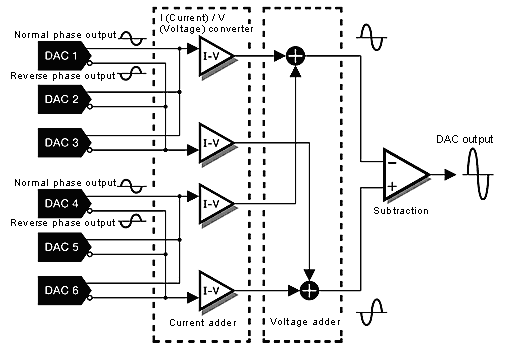 Fig. 3 MDS++ operation principle
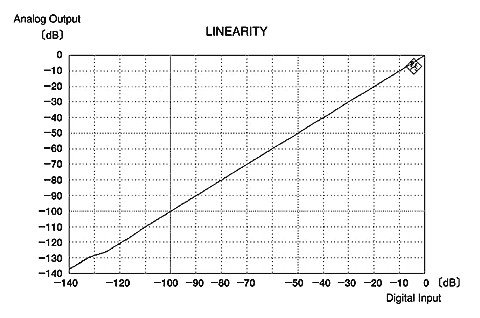 Fig. 4 Linearity of MDS++ converter
Figure 4 shows the amazing linearity of an MDS++ D/A converter. The virtually straight line is due to the almost complete absence of distortion and noise.
 Accuphase Laboratory, Inc.
enrich life through technology