

MCS is a technique for improving the performance of analog amplification circuitry. The underlying principle is similar to the MMB and MDS systems from Accuphase. Rather than simply connecting multiple circuits in a parallel pattern to form a single circuit, performance is improved significantly by actually driving the multiple circuits in parallel.
How MCS works
Figure 1 shows the circuit configuration of the model CX-260, where the MCS principle was first introduced. Originally developed as a six-channel preamplifier for surround sound applications, the CX-260 also features a two-channel mode. Rather than having the remaining four channels sit idle, they are used also in this mode, with three circuits for each channel operating in parallel.
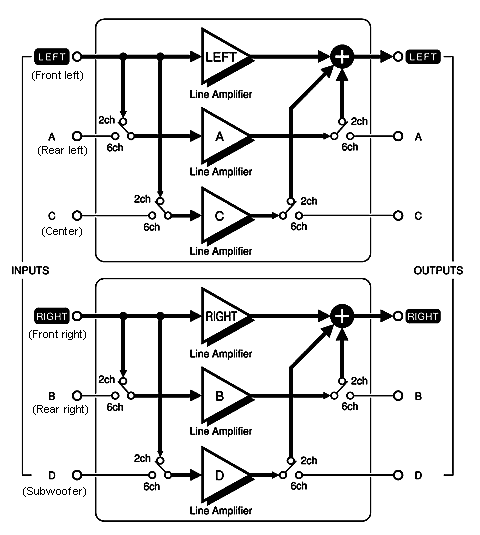 Fig. 1 MCS operation principle
Performance aspects such as THD and S/N ratio can be considered as being unique to each circuit, with characteristics that do not exhibit a fixed phase relationship to each other. As in MDS, the performance improvement that can be expected when combining the output of each circuit is the square root of the number of circuits (<root>n). The crucial point here is that circuits as a whole and not simply active components (such as transistors or FETs) are connected in parallel.
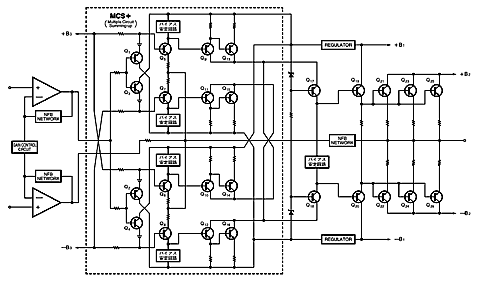 Fig. 2 Circuit diagram of P-3000
Figure 2 shows the circuit diagram of the model P-3000. The area enclosed by the broken lines is the MCS section where two circuits are operating in parallel. The principle is totally different from driving circuit components in parallel, which is employed in the output stage where power transistors are arranged in a parallel configuration. This approach which is used mainly in power amplifiers has the effect of lowering the output impedance and providing higher power capability.
The MCS principle from Accuphase affords a notable improvement in S/N ratio and THD and is used widely in our preamplifiers, power amplifiers, and other components.
 Accuphase Laboratory, Inc.
enrich life through technology